Crystal Skulls: Ancient Aztec Relics or Modern Fakes?
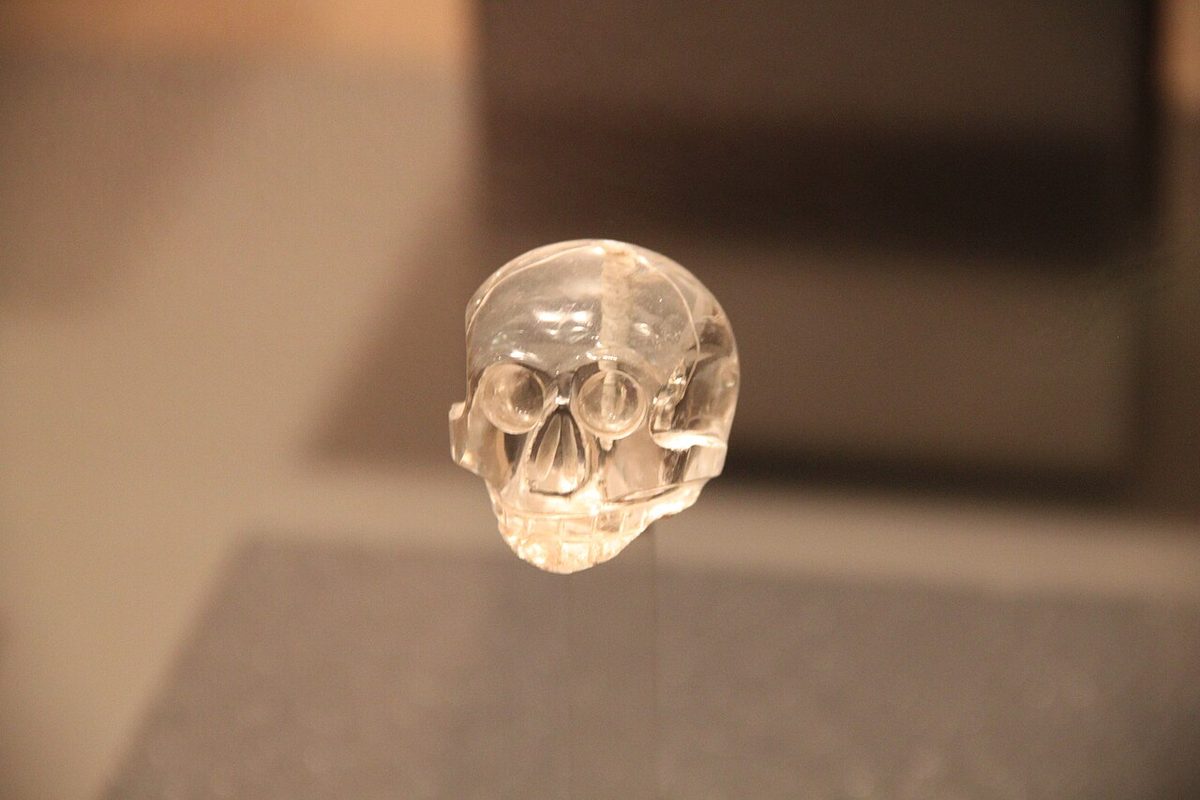
The crystal skulls — life-size human skulls carved from clear quartz, said to be ancient Aztec or Maya relics with mystical powers, or, according to Ancient Aliens, gifts from extraterrestrials — are among the most famous "mysterious artifacts" in the world 1. But scientific analysis by the British Museum, the Smithsonian, and French laboratories has reached a clear verdict: they are 19th and early-20th-century fakes, carved with modern rotary tools from quartz that does not even come from the Americas 2. Here is a fair, evidence-based look at where the crystal skulls really came from.
What Are the Crystal Skulls?
There are around 13 known life-size crystal skulls, of which 4 are famous: the British Museum skull, the Paris skull, the Mitchell-Hedges skull, and the Smithsonian skull 1. Each was presented as a pre-Columbian Mesoamerican artifact, and over time the objects were wrapped in New Age lore, such as the story that 13 skulls will one day unite to save humanity, and then in ancient-astronaut claims 1. The 2008 film Indiana Jones and the Kingdom of the Crystal Skull cemented the legend in pop culture 2. One fact frames everything that follows: not a single crystal skull has ever been recovered from a documented archaeological excavation 2.
The Tool Marks Give It Away
The decisive evidence is microscopic 2. When researchers examined the skulls under a scanning electron microscope, they found tool marks left by modern high-speed rotary lapidary wheels using hard abrasives such as carborundum or diamond, not the slow hand-abrasion methods available to Maya and Aztec carvers 3. The Smithsonian skull went further: analysis detected silicon carbide, a synthetic abrasive that only came into use around the 1950s, making that skull's manufacture strikingly recent 2. Real Mesoamerican skull imagery was carved crudely from basalt, obsidian, or jade, and clear-quartz skulls simply do not appear in the archaeological record 4.
The Quartz Isn't From Mexico
The raw material tells the same story 4. Impurities and inclusions in the quartz trace the stone to Brazil or Madagascar, not to Mesoamerica 4. In the late 19th century, those regions exported rock crystal to Europe, where the town of Idar-Oberstein in Germany was the great center of quartz carving 5. In other words, the skulls were almost certainly made in Europe and passed off as American antiquities, not carved by pre-Columbian craftsmen at all 5.
Where Did They Come From?
The trail leads to Eugène Boban, a French antiquities dealer active in Paris from the 1860s through the 1880s who sold both genuine Mesoamerican pieces and fakes 3. The British Museum skull first surfaced in his shop around 1881 3. Boban tried to sell it in Mexico City in 1885 as an Aztec relic, where a museum curator denounced it as a fake, then moved to New York and sold it through Tiffany and Co. in 1886, and the British Museum acquired it in 1897 3. Tellingly, Boban himself admitted at a Paris conference in 1900 that many so-called pre-Columbian rock-crystal skulls had been "so adroitly made as almost to defy detection" 5.
The "Skull of Doom" Story
The Mitchell-Hedges skull has the most romantic origin tale 3. Anna Mitchell-Hedges long claimed she discovered it in 1924 inside a Maya temple at Lubaantun in Belize, on her 17th birthday 4. The documents say otherwise: her father, F.A. Mitchell-Hedges, bought it at a Sotheby's auction in London on 15 October 1943 from the dealer Sydney Burney for around £400 3. His excavation companions never mentioned a skull, and Anna does not appear in the dig photographs 4. A 2007 study found rotary-tool marks and concluded the skull was probably carved in Europe between about 1900 and the 1930s, likely copied from the British Museum skull 3. It is often blamed on Boban, but he died in 1908, decades before this skull appeared, so he cannot be tied to it 3.
So Why Do People Believe?
The skulls are genuinely striking and eerie, the human skull is a powerful symbol, and quartz carries a long association with mysticism 2. F.A. Mitchell-Hedges branded his the "Skull of Doom" in his 1954 memoir, claiming doubters fell ill or died, and his daughter kept the legend alive through lectures and 1970s television, adding flourishes such as the skull "sweating" when President Kennedy was assassinated 3. Ancient Aliens and Hollywood did the rest 2. But a compelling story is not evidence, and every physical test points the other way 2.
The Bottom Line
The crystal skulls are not ancient Aztec or Maya artifacts, and they are certainly not extraterrestrial 2. Tool-mark analysis shows modern rotary carving, the quartz comes from Brazil or Madagascar, and no example has ever been excavated from a genuine site 34. They are remarkable 19th and 20th-century craft objects wrapped in an irresistible legend, which is a fascinating story in its own right, just not the one the myth tells 2.
Related fact-checks: [Giorgio Tsoukalos and Ancient Aliens](https://innumbra.com/post/giorgio-tsoukalos-ancient-aliens-fact-check) and [The Piri Reis Map](https://innumbra.com/post/piri-reis-map-antarctica-fact-check).
Frequently Asked Questions
Are the crystal skulls really ancient? No. Analysis shows they were carved with modern rotary tools in the 19th and early 20th centuries, not by pre-Columbian cultures 3.
How do we know they're fake? Scanning electron microscopy revealed modern tool marks, one skull contained a 1950s-era abrasive, and the quartz comes from Brazil or Madagascar 24.
Where does the Mitchell-Hedges skull actually come from? F.A. Mitchell-Hedges bought it at a Sotheby's auction in 1943; the 1924 "jungle discovery" was a later embellishment 3.
Did the Aztecs or Maya carve crystal skulls? There is no evidence they did; their skull art was carved crudely from basalt, obsidian, or jade, and no crystal skull has ever been excavated 4.
Who made the crystal skulls? They were most likely carved in Europe, probably in Idar-Oberstein, Germany, and sold as pre-Columbian antiquities 5.
References
- https://en.wikipedia.org/wiki/Crystal_skull
- https://www.smithsonianmag.com/history/the-smithsonians-crystal-skull-51638609/
- https://archive.archaeology.org/online/features/mitchell_hedges/facts.html
- https://ahotcupofjoe.net/2016/12/crystal-skulls-a-little-clarity/
- https://www.heritagedaily.com/2023/01/the-truth-behind-the-crystal-skulls/145970