The London Hammer: A 400-Million-Year-Old Tool?
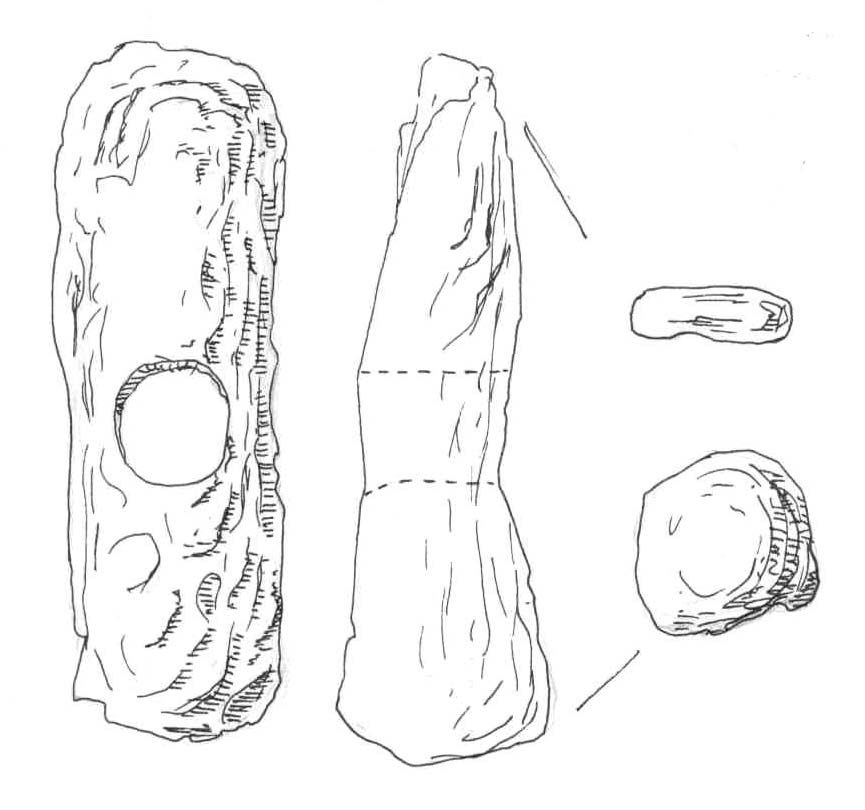
The London Hammer — an iron-and-wood hammer found encased in rock in Texas — is promoted as a modern tool trapped inside stone up to 400 million years old, supposed proof that humans coexisted with ancient rock and that the geologic timescale is wrong 1. The reality is far more ordinary: it is a 19th-century miner's hammer that became naturally cemented into a rock concretion relatively recently 3. Here is a fair, evidence-based look at the famous "out-of-place" artifact.
What Is the London Hammer?
In June 1936, Emma and Max Hahn spotted a piece of wood sticking out of a rock nodule near Red Creek in London, Texas — not London, England 1. About 10 years later, their son cracked the nodule open and found an iron hammer head with a wooden handle, roughly 6 inches (15 cm) long, partly embedded in a small, limey rock concretion 1. The object now sits in the Creation Evidence Museum run by Carl Baugh in Glen Rose, Texas, where it is displayed as evidence against mainstream geology 5.
What's the Claim?
The young-earth creationist Carl Baugh acquired the hammer around 1983 and began promoting it as a "pre-Flood" artifact 1. The argument is simple: if a manufactured hammer is embedded in rock hundreds of millions of years old, then humans must have existed in that deep past, which would overturn the entire geologic timescale 4. This is an artifact-and-geology question, not a religious one, and it turns entirely on a single issue: how old the surrounding rock actually is 3.
The Rock Isn't Ancient
Here is the heart of the matter: the concretion is not ancient 3. As the geologist J.R. Cole explained in 1985, minerals dissolved in groundwater from chemically soluble rock, such as limestone, can harden and cement around an object dropped on the ground or into a crack, and they can do so within decades to a century 13. So a 19th-century hammer left by a creek could easily be encased in a recent mineral concretion 3. The clincher is inside the nodule itself: it contains an unfossilized mollusk shell, which shows the material is recent, not hundreds of millions of years old 3.
It Was Never Found in Ancient Rock
Crucially, the hammer was never documented embedded in solid bedrock 3. It was found in a loose nodule beside a creek and has never been reliably tied to any geologic formation 4. And Baugh's claim about which period the rock belongs to keeps shifting — Ordovician in some accounts, Silurian in others, and Cretaceous in still others 3. That inconsistency is a red flag, because the surrounding rock was never actually dated in a controlled geologic context in the first place 4.
A 19th-Century Miner's Hammer
The hammer's design is plainly that of a late-19th-century American miner's or quarryman's hammer 1. A reported carbon-dating result on the wooden handle placed it somewhere from the present to about 700 years old, in other words recent rather than ancient, though Baugh explained the result away 5. Tellingly, Baugh has not allowed independent testing of the handle or the concretion matrix, the very analysis that a genuine world-changing discovery would invite 5. Investigator Glen Kuban, a former creationist who compiled the definitive review of the case, concludes it is simply an ordinary old tool encased by natural means 3.
Why It Persists
The London Hammer endures because it looks impossible: a modern tool locked inside a rock is a striking image 5. And because the original context is missing — no in-place bedrock, no documented layer — the "trapped in ancient stone" story travels far and fast 5. But an object that merely looks anomalous, with a perfectly mundane explanation, is not evidence against the age of the Earth 3.
The Bottom Line
The London Hammer is a 19th-century iron hammer that became naturally cemented into a mineral concretion, not a 400-million-year-old tool 3. It was never found in dated ancient rock, concretions of this kind form quickly, and the owner will not permit testing 135. It is a genuine curiosity of geological happenstance, and nothing more 3.
Related fact-checks: [Crystal Skulls: Ancient Relics or Fakes?](https://innumbra.com/post/crystal-skulls-aztec-fact-check) and [Puma Punku: Alien Technology or Ancient Skill?](https://innumbra.com/post/puma-punku-alien-technology-fact-check).
Frequently Asked Questions
Is the London Hammer really millions of years old? No. The hammer is a 19th-century miner's tool, and the rock around it is a recent mineral concretion, not ancient bedrock 13.
How can a modern hammer be encased in rock? Dissolved minerals from soluble rock can harden around an object within decades to a century, forming a concretion 3.
Where is the London Hammer now? In the Creation Evidence Museum in Glen Rose, Texas, where it is displayed as a "pre-Flood" artifact 5.
Was it found inside an ancient rock layer? No. It was found in a loose nodule by a creek and never reliably linked to any dated geologic formation 4.
Has the hammer been properly tested? Not independently. The owner has declined to allow testing of the handle or the surrounding concretion 5.
References
- https://en.wikipedia.org/wiki/London_Hammer
- https://www.britannica.com/science/concretion
- http://paleo.cc/paluxy/hammer.htm
- http://www.badarchaeology.com/out-of-place-artefacts/very-ancient-artefacts/the-london-artifact/
- https://www.discovermagazine.com/the-london-hammer-mystery-points-to-a-modern-tool-not-an-ancient-relic-49233